
Marvell stellt mobilen 1.5GHz Dreikern-Chipsatz für Smartphones und Tablets vor

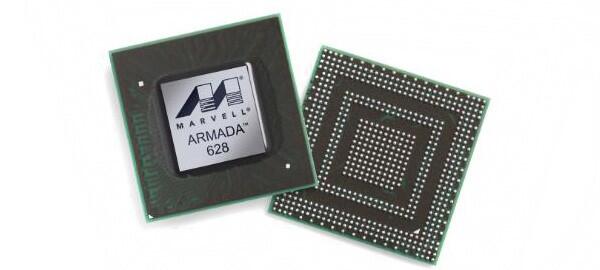
Marvell hat per Pressemitteilung bekannt gegeben, einen mobilen 1.5GHz Dreikern-Chipsatz entwickelt zu haben. Dieser dürfte die aktuelle Konkurrenz recht alt ausssehen lassen, denn die Leistungsdaten lesen sich ausgezeichnet.
So soll der Chip namens Armada 628 im Gegensatz zu Samsungs Hummingbird-Chip, der ca. 90 Millionen Dreiecke pro Sekunden berechnen kann, ganze 200 Millionen Dreiecke pro Sekunde schaffen. Der neue Prozessor läuft mit drei Kernen, von denen zwei auf 1,5 GHz getaktet sind und eine Wiedergabedauer von 1080p 3D-Video mit einer „ultra low power“ Technologie von 10 Stunden ermöglichen. Zudem sollen locker 140 Stunden Musikwiedergabe realisierbar sein und erstmals USB 3.0 auf einer mobilen Plattform unterstützt werden.
Klingt fast zu schön um wahr zu sein und derzeit ist es das auch noch, denn eine Verfügbarkeit ist aktuell nur für ausgewählte Testnutzer möglich. Weitere Details gibt es in der Pressemitteilung.
Da ich kein Gamer bin, komme ich auch mit meinem HTC Desire und dem 1GHz Snapdragon-Prozessor aus, ob ich wirklich Full HD 3D-Filme mit meinem Handy schauen muss, lasse ich mal dahingestellt. Bei der technischen Entwicklung heutzutage wird es aber sicher Einsatzzwecke geben, die auch diese Leistung benötigen. Was meint Ihr, wofür braucht man solche Rechenpower im mobilen Gerät?
Marvell Raises Technology Bar Again with World’s First 1.5 GHz Tri-Core Processor Delivering Dual Stream 1080p 3D Video for Smartphones and Tablets
Game Changer: Ultra-low power, ultra-high performance ARMADA three-core processor first to feature 3D graphics performance with quad unified shaders for 200 million triangles per second delivered on mobile devices
SANTA CLARA, Calif., Sept. 23 /PRNewswire/ — Marvell (Nasdaq: MRVL), a worldwide leader in integrated silicon solutions, today introduced the world’s first 1.5 GHz tri-core application processor, the Marvell® ARMADA™ 628. This product incorporates a full System-on-a-Chip design (SoC) with three high performance Marvell-designed, ARM-compliant CPU cores operating as the world’s first commercially available heterogeneous, multi-core, applications processor.
„Marvell has once again set the benchmark for the rest of the industry with the world’s first 1.5 GHz tri-core processor, delivering dual stream 1080p 3D video and 3D graphics performance with quad unified shaders for 200 million triangles per second delivered on ultra-low-power, long battery life smartphones and tablets,“ said Weili Dai, Marvell Co-founder and Vice President and General Manager of Marvell Semiconductor’s Consumer and Computing Business Unit. „This is important because today’s consumers expect robust enterprise and consumer applications delivered to the palm of their hands. Marvell is uniquely equipped to lead this mobile revolution as the semiconductor industry’s one-stop shop solution provider. This is an example of Marvell’s unique ability to take a diverse cutting edge technology portfolio and integrate into differentiated solutions to give our customers game-changing advantage.“
The new ARMADA 628 tri-core processor incorporates a number of advanced processing and power management features. The tri-core design integrates two high performance symmetric multiprocessing cores and a third core optimized for ultra low-power. The third core is designed to support routine user tasks and acts as a system management processor to monitor and dynamically scale power and performance. The tri-core architecture provides superior performance and lower power over dual-core designs while maintaining industry compatibility and leadership – ensuring a richer, faster and smoother experience than any other ARM-based processor available today.
„Marvell’s groundbreaking tri-core architecture is a unique solution to a long-time problem-how to achieve enterprise performance without breaking the limited power budget of smartphones, tablets and other mobile consumer devices,“ said Linley Gwennap, principal analyst of The Linley Group. „With Marvell’s ARMADA 628, consumers can anticipate better visual, dynamic experiences on an array of new mobile devices.“
The architecture is analogous to a hybrid muscle car. The ARMADA 628 is intended to perform like a race car engine on demand, while still delivering the frugal gas-mileage of a hybrid automobile. In real world terms, this enables the ARMADA 628 to play more than 10 hours of full 1080p HD video or 140 hours of music on a single charge while still providing 3 GHz of raw computational horsepower.
Marvell’s ARMADA 628 tri-core CPU comprises a complete SoC design – a first for the industry. In addition to the tri-core CPU, there are six additional processing engines to support stunning 3D graphics, 1080p video encode/decode, ultra high fidelity audio, advanced cryptography, and digital photo data processing – for a total of nine dedicated core functions.
The ARMADA 628 is also designed to be the first mobile CPU to provide high-speed USB 3.0 connectivity, which offers 10x faster performance than USB 2.0.
About ARMADA 628
The ARMADA 628 is based on a Marvell-designed ARM v7 MP compatible CPU offering 1.5 GHz performance. It offers support to use LP-DDR2 or DDR3 memory up to 533 MHz, a highly flexible display controller capable of driving four simultaneous displays at up t o 2K x 2K resolution, and a highly robust security subsystem that includes a secure execution processor. An integrated 3D engine renders 200 million triangles per second for an immersive game play experience and a multi-format video engine supports dual stream 1080p video for a true 3D visual experience. In addition, the ARMADA 628 supports DirectX, Open GL ES 2.0, and Open VG 1.1 – ensuring complete compatibility with the most hotly anticipated mobile game titles.
ARMADA 628 supports RIM OS, Android™, Linux, Windows Mobile, and full Adobe Flash.
Marvell has a long history of delivering multi-core technology to customers for use in a broad variety of applications ranging from home networking, gateways, all the way up to computing-intensive enterprise applications. Most recently, Marvell announced the first implementation of quad-core technology for the ARM ecosystem, further demonstrating Marvell’s ability to deliver high performance, flexible technology that meets the silicon requirements of numerous tier-one customers, regardless of the end application.
Key Features
- World’s first „tri-core“ application processor
- Up to 1.5 GHz for the two main cores and 624 MHz for the third low power core
- „Heterogeneous multiprocessing“ with „hardware-based Cache Coherence“
- 1 MB System Level 2 Cache
- Platform leading multimedia capabilities, including support for both WMMX2 and NEON acceleration; and a highly optimized pipelined VFPv3 floating point engine
- Member of the ARMADA family of processors for easy software porting
- 1080p dual stream 3D video applications (30 FPS, multi-format)
- Ultimate 3D graphics performance with quad unified shaders for 200 million triangles per second (MT/s)
- High performance, integrated image signal processor (ISP)
- Ability to project images on multiple simultaneous displays
- 2 LCDs
- 1 HDMI
- 1 advanced EPD controller
- Peripherals support: USB 3.0 Superspeed Client, MIPI CSI, MIPI DSI, HDMI with integrated PHY, UniPro, Slimbus, SPMI
Availability
The ARMADA 628 is currently available for sampling to customers. For more information please go to


Kommentarbereich jetzt laden